Momentum MarketingHow to come back after you went quiet
Everyone believes that if you stop posting, it is over. The account is cold, the algorithm has forgotten you, and getting back means starting from nothing. I have disappeared from Threads more times than I can defend — six of them are circled on the chart below, and I have done it twice more since, for fifty days at a stretch. Every single time the account came back inside a week, and the last one I measured to the day. I call it momentum marketing, and this is all of it, numbers included.
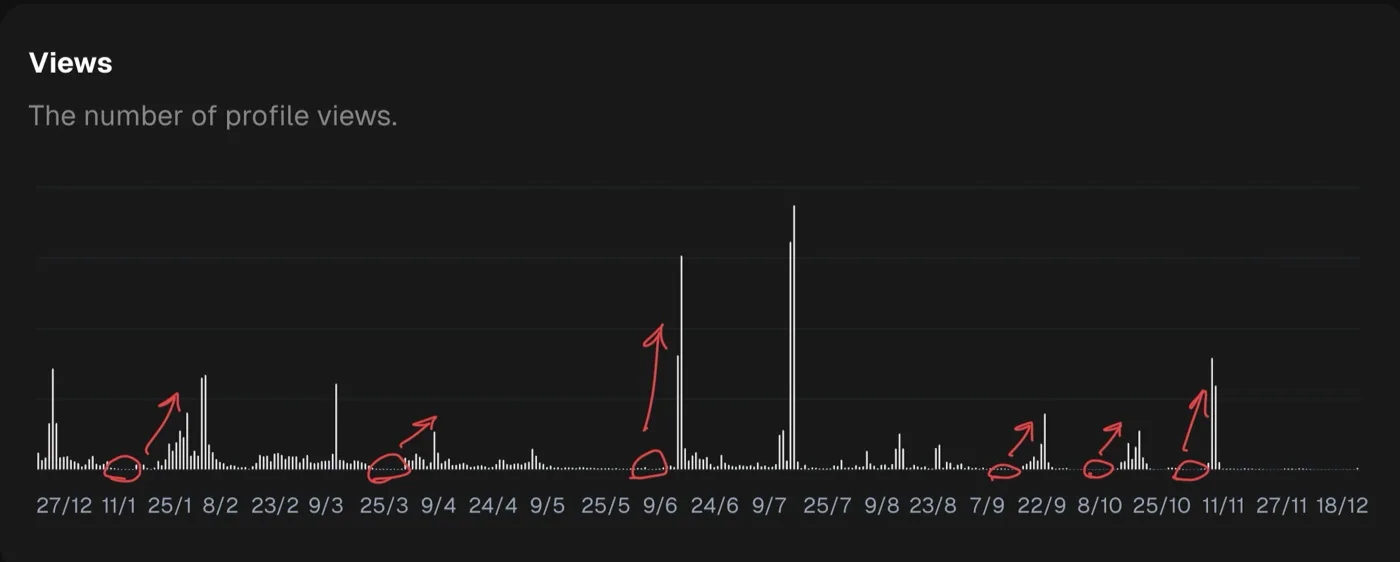
read it properly
What the graph actually shows
Look at November. I posted nothing for a week. Then two days happen, and then nothing again for three weeks.
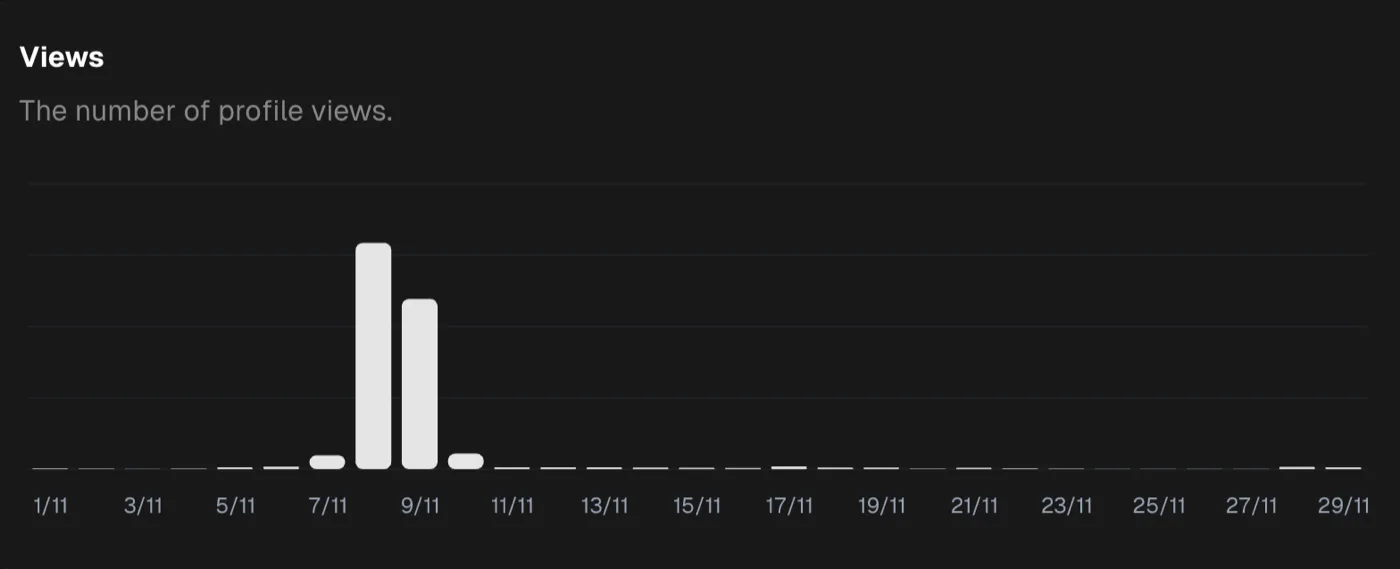
That post did 316,000 views. It was not new. I had published the exact same words in July, where it did 510,000. I changed nothing, waited about four months, and posted it again to an account that had been silent.
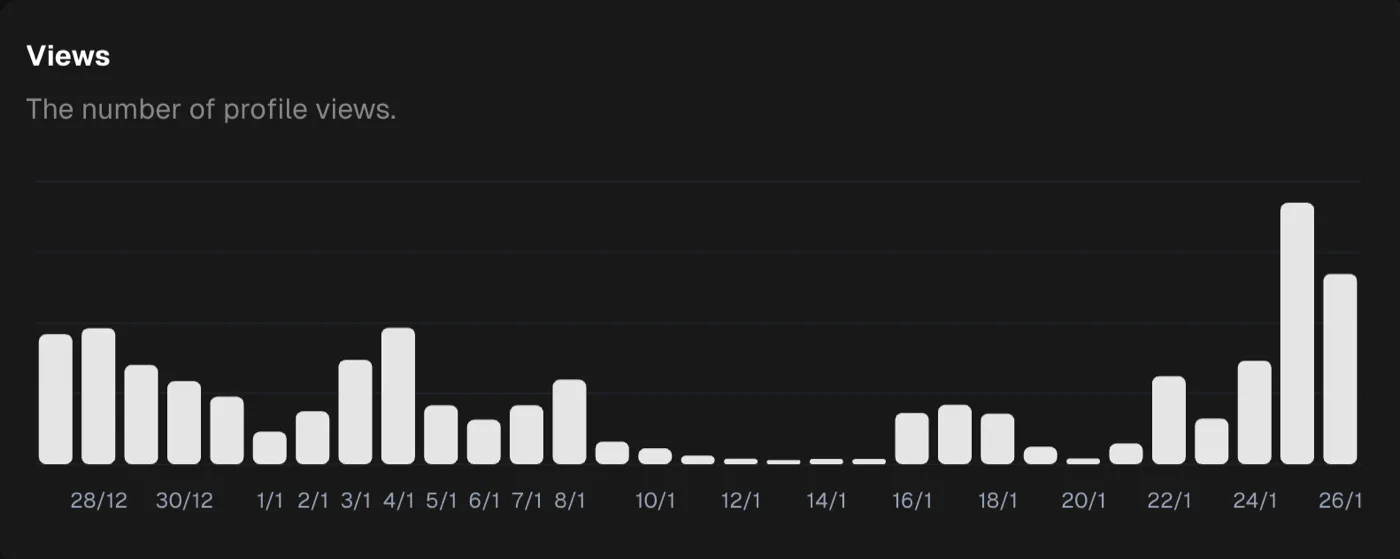
January is the same shape at the start of the year: nothing from the 9th to the 21st, then a climb over four days.
And the year underneath all of it: 791 posts spread across 140 days. I published on thirty-eight per cent of the days and nothing on the other sixty-two. My longest unbroken streak was ninety-six days. My current one, as I write this, is zero.
the one I measured properly
Seven days, day by day, in numbers
Last summer I ran this deliberately and kept the analytics. Fifty days without posting. The account was doing somewhere around three hundred profile views a day, which is what a dead account looks like. Then seven days at eight to nine posts a day.
The full curve, because the shape matters more than the peak: 163,459, then 142,197, then 84,990, then 23,586, then 7,322, then 3,558, then 2,150. By the ninth day it was back under a thousand.
Four hundred and twenty-seven thousand views in seven days, from an account that had been silent for fifty. And notice where it starts. There was no warm-up. Day one was the biggest day of the week.
the whole thing
The seven day plan
Four things run at once for a week. The daily rhythm is the same every day; what changes is what you are publishing. Do not read this as seven separate tasks — read it as four streams, described underneath, laid out over seven days.
- Day 1 — full volume, from the first hour. Export your last three to six months and sort by views while the first posts go out. Do not ease in. In the week I measured, day one was the single biggest day, from an account that had been dead for fifty days — there is no warm-up period to respect. What day one needs is spread: ten posts covering different tones and lengths, because you have no idea yet which one the platform will pick up.
- Day 2 — volume plus your first vault post. Pick a mid-range performer from the export, not your best one, and publish it verbatim. You are testing that the mechanism works before you spend your strongest card.
- Day 3 — your top performer from the vault. Not because the account is "warmer" — it does not work like that — but because spreading your three or four strongest cards across days two, three and five gives each one its own day to be seen. Two big posts on the same day compete with each other.
- Day 4 — the remixes start. Your first rewritten versions of the posts from days 2 and 3 go out alongside the volume. Same structure, different content.
- Day 5 — other people's shapes. The posts you built from studying creators you admire. Plus your second-best vault post.
- Day 6 — double down on whatever moved. By day six something has outperformed. Write two more in that shape and publish them the same day, while it is still warm.
- Day 7 — the long story. Look at the curve above: whatever hit early is already spent by day seven. That is not failure, it is the shape of every one of these weeks. Day seven is for the piece that keeps working after the spike is gone — the personal one, the one you have been sitting on.
stream one
Volume, honestly
Eight to ten posts a day, mixing one-liners and long form. That number sounds like hustle advice and I want to be precise about why it is not.
Go back to the November chart. One post out of everything I published that month produced the spike. Not the best-written one, not the one I worked hardest on. Volume does not create the spike — volume creates the number of chances at one. You are not out-working anybody. You are increasing how many draws you get in seven days.
Do not write ten new things a day. Nobody can, and trying is how the week ends on day three. Most of the ten come from the vault and the remixes.
stream two
The engagement hour
Forty-five minutes to an hour a day, every day of the seven, and it is the half of this that people skip because it does not produce anything with your name at the top.
A reply on Threads lands in feeds with the same real estate as a post you wrote from scratch. So do not treat it as the consolation prize. The rule is simple and most people break it: write every reply so that it would still make sense if you deleted the post above it. If your reply only works as a response, it is a comment. If it stands alone, it is a post that happens to be sitting underneath somebody with more reach than you.
Where to spend the hour: under accounts that are bigger than you, in the first fifteen or twenty minutes after they post, in the space your people are already reading. Not spread across fifty accounts. Eight to ten a day, the same ones all week, so that by day five you are a name people recognise rather than a stranger agreeing with them.
stream three
The vault: republish, word for word
Export the last three to six months. Sort by views. The top ten posts are your vault, and you are going to publish them again exactly as they were — not rewritten, not refreshed, not "updated for 2026". The same words.
This is the instruction people refuse to believe, so here are mine.
| The post | First run | Second run | Returned |
|---|---|---|---|
| "I went out on a date with this guy" | 510K | 316K | 62% |
| "I'm 34, and your 30s hit different" | 213K | 117K | 55% |
| "A 17-hour first date" | 491K | 140K | 29% |
Between a quarter and two thirds of the original reach, for zero writing. The 316,000 one is worth sitting with: that is a repost, on a dead account, and it outperformed almost everything I have ever written from scratch.
Two rules that make the difference between this working and this looking desperate.
- Leave at least ninety days. My gaps were 95, 100 and 116 days. Inside three months the same people are still scrolling past it and it reads as a loop. After three months the feed has turned over and most of the audience has genuinely never seen it.
- Change nothing. Not the emoji, not the line breaks, not one word of the hook. You are not trying to improve it. You already know this exact arrangement of words worked, and every edit is an untested variable in something that was already proven.
stream four
Three new ones from every old one
The vault runs out. Ten posts across seven days is not enough volume, and republishing is the easy half. The other half is using each top performer as a template.
Three variants from each, and here is the rule that stops them being worse copies: change exactly one variable.
Change two of those and you have written a different post, which may be fine but is no longer an experiment. You learn nothing about why the original worked, and you have thrown away the only asset you had: a structure with evidence behind it.
stream four, continued
Other people's best, not other people's words
Your own archive only contains shapes you have already tried. To find ones you have not, look at the people you admire — but look at the right thing, which is not what is on their profile now.
Take five to eight creators whose audience overlaps yours, pull their last thirty days, and sort by engagement rather than by recency. Their profile shows you what they posted most recently. You want what worked, which is a different list entirely and is usually three weeks back.
I use Sortaic for this, which is a Chrome extension that sorts any Threads profile by likes, replies or reposts and exports it. Full disclosure: I built it. Every screenshot on this page is from it. There is a whole guide on the method if you want the long version, including what to look at in the export once you have it.
What you take is never the words. It is the answer to three questions about each of their top posts: what kind of post is it, what does the first line do, and what does it ask of the reader. Those three answers are a template, and templates belong to nobody.
the pattern underneath
Why the ones that travel, travel
After a year of this I stopped guessing. Everything of mine that went past a hundred thousand pulls one of five levers, and none of them is a trend.
When you are staring at day four with nothing, do not look for a topic. Pick a lever, then find the thing in your own week that pulls it.
the column nobody reads
How to know whether it worked
Not views. Here are my own posts sorted by replies, and then by reposts.
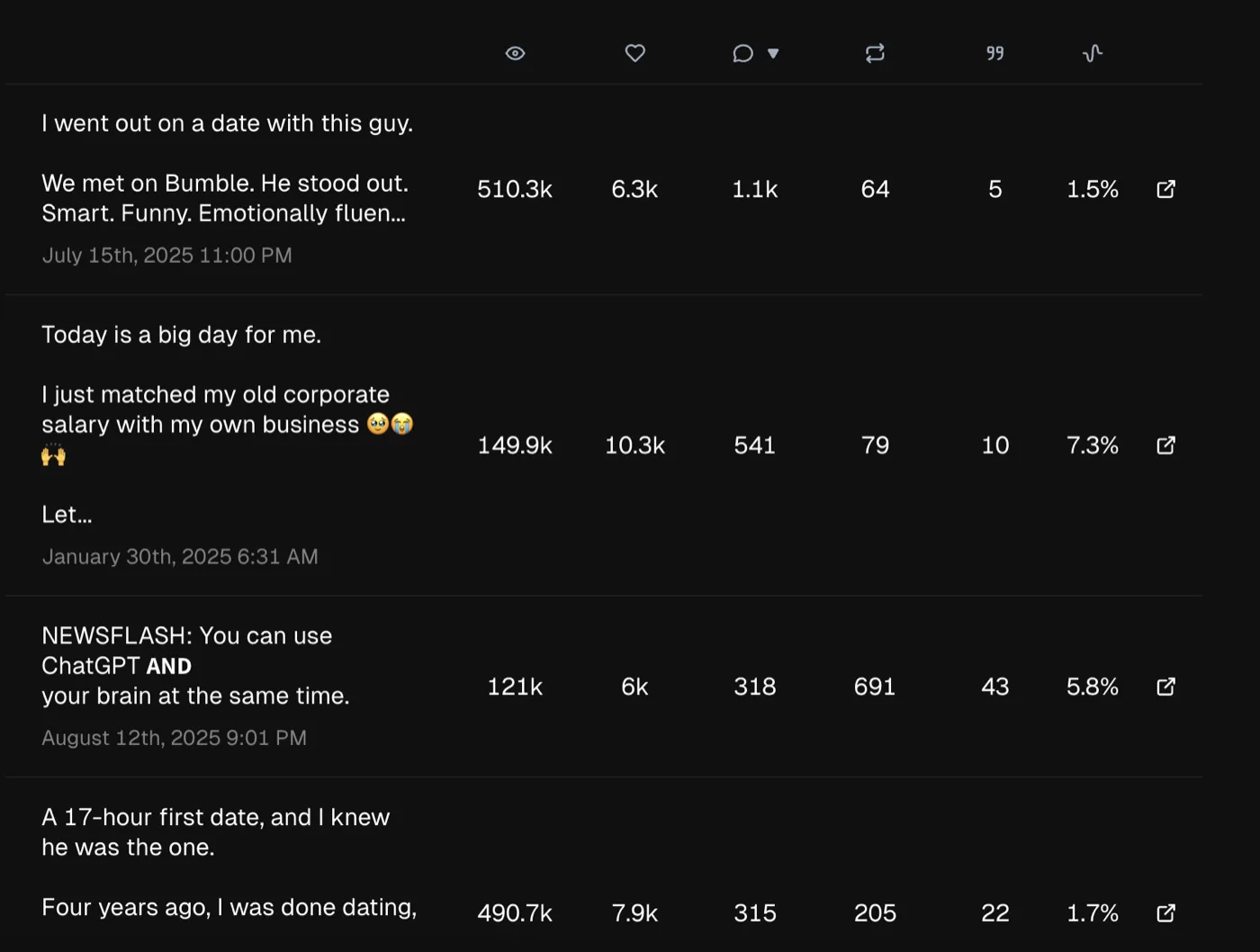
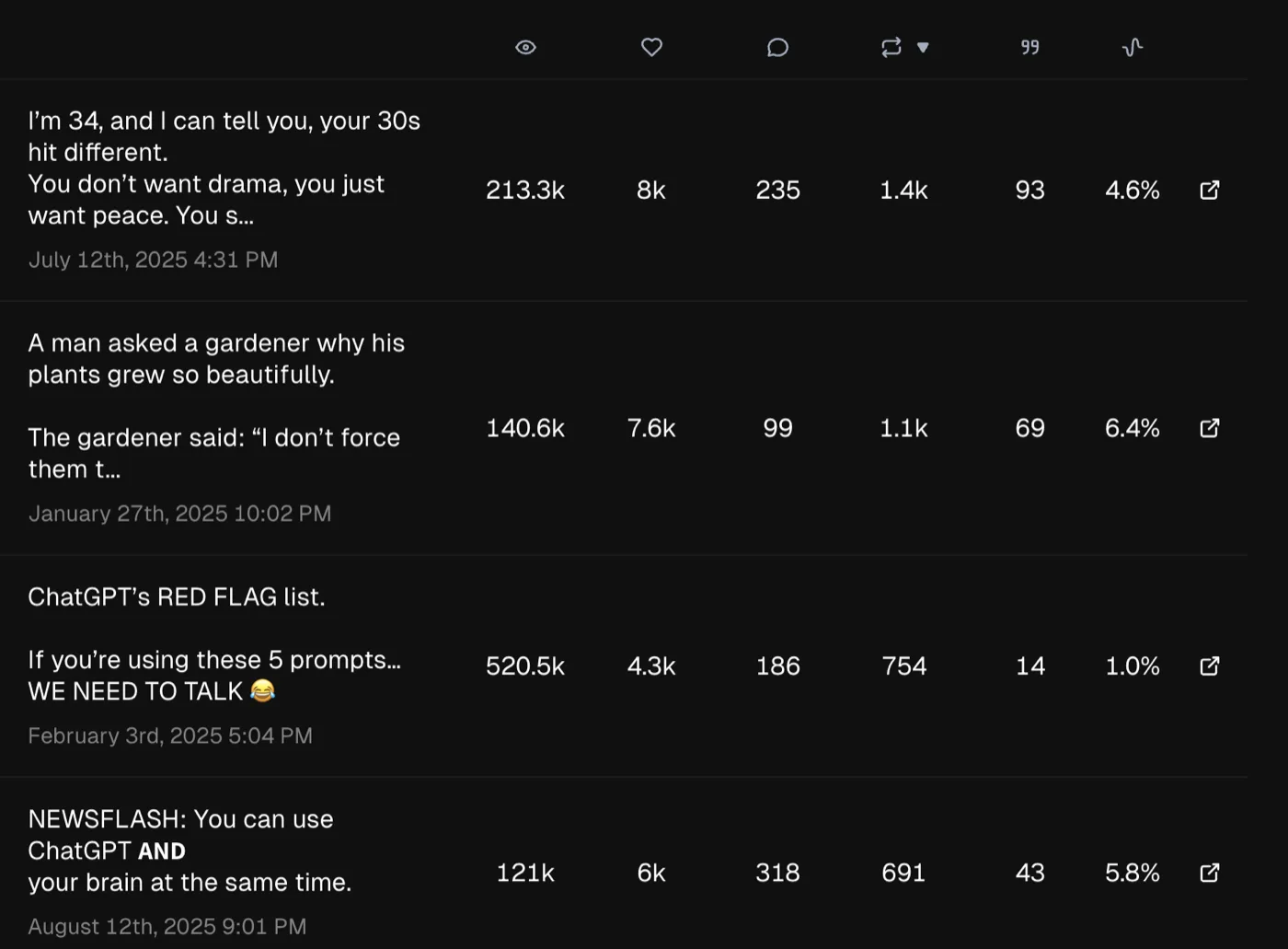
The clearest version of this is from the week I measured. Two posts, two days apart.
| Views | Likes | Reposts | Engagement | |
|---|---|---|---|---|
| The joke about selling rocks on Etsy | 223,562 | 5,227 | 14 | 2.4% |
| One line about who is actually on Threads | 87,000 | 16,701 | 352 | 19.9% |
Two and a half times fewer views. Three times the likes. Twenty-five times the reposts. If you had judged that week on views you would have concluded the joke was the win and written more jokes.
Three things to take from all of this.
- Watch profile views, not post views. Every chart at the top of this page is profile views, and that is deliberate. One post going viral is luck. Profile views climbing over several days means people went looking for you, which is the only thing that survives the week.
- Engagement rate tells you which posts to build on. A 1% post got you reach. A 7% post got you people. During a comeback week you want reach first and people second, so publish both — but when you pick what to remix on day 6, remix the 7% one.
- Reposts are the compounding number. A like is one person. A repost is a borrowed audience. The 140K post with 1,100 reposts did more for the account than the 520K post with 754.
the number that keeps me honest
What 427,000 views is actually worth
Here is the part I have never seen anyone publish, and it is the reason I trust the rest of this page.
That seven day week produced 427,000 views. It also produced eighty new followers. I went into it on 18,949 and came out at 19,029. Two weeks later I was at 19,016, so some of them left again.
There is a second number in there, and it is the one to hold onto if you are frightened of going quiet. During the fifty silent days, I was losing about three followers a day. Over the eleven days I looked at closely, the silence cost me twenty-nine people.
That is the actual price of disappearing. Not the account. Not the audience. Twenty-nine.
three ways to waste the week
What not to do
the honest part
This is a sprint, and it is supposed to end
Eight to ten posts and an hour of replies a day is not a way to live. I would not do it for a month and I would not tell you to. I do it for seven days, two or three times a year, and then I stop — which is how the silences on that first chart got there in the first place.
That is the actual argument of this page. Not that you should never go quiet. That going quiet costs you far less than you have been told, and that coming back is a week of deliberate work rather than starting over. Six times, on the same account, on the chart at the top.
If you have been away for two months and have been telling yourself it is too late to bother: it took me seven days, and the best post of my year was one I had already written.